
Ethiopia's Hayli Gubbi Volcano Roars To Life In Explosive First Eruption
Language
Reading Level
Listen to Article
Alignment
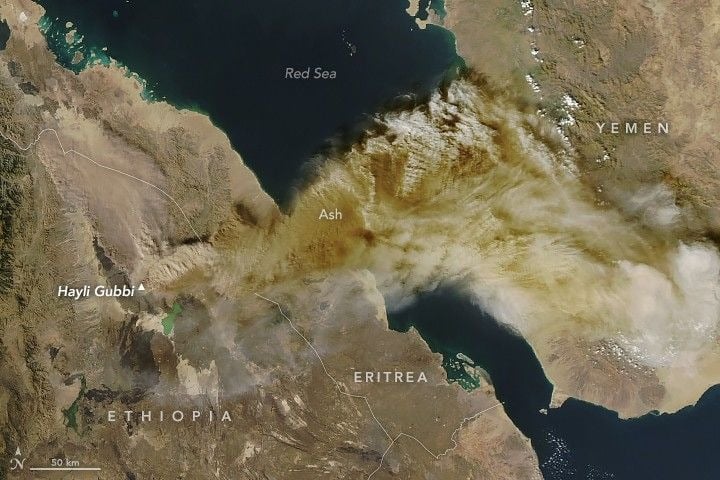
On the morning of November 23, 2025, the residents of Ethiopia's remote Afar region were jolted awake by an unexpected event. The nearby Hayli Gubbi volcano erupted for the first time in recorded history!
Hayli Gubbi sits in the East African Rift, a long system of cracks and valleys. It begins in northeastern Ethiopia and continues through eastern Africa toward Mozambique. In this rift zone, the land is slowly pulling apart as tectonic plates move a few millimeters each year. This movement allows magma to rise to the surface, feeding the many active volcanoes in the area.
Even so, the volcano's massive explosion surprised experts. Hayli Gubbi is a shield volcano. These volcanoes usually erupt quietly with soft lava flows. But satellite data showed the plume of ash and gas rose about 6 to 9 miles (10 to 15 km) into the sky. The vibrations from the eruption were even felt in the neighboring country of Djibouti. Scientists believe the sudden blast may have occurred because the thick magma trapped a large amount of gas. This built up pressure until it finally burst.
Thankfully, no one was killed in the eruption. However, the ash cloud caused serious problems both locally and globally. Near the volcano, thick ash covered villages. This ash ruined the grazing fields and polluted water sources. Many residents also had trouble breathing due to the heavy ash in the air. From there, the cloud drifted across the Arabian Sea, reaching as far as South Asia. Because ash is dangerous for jet engines, many airlines had to cancel or reroute flights. This caused widespread travel delays in the region.
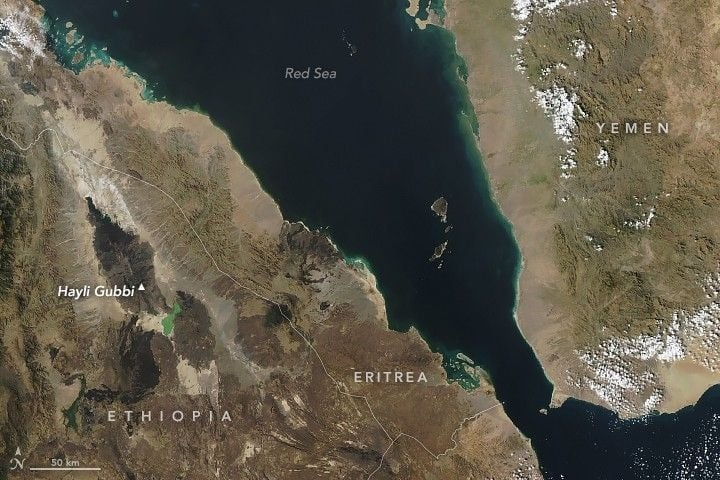
The volcano's sudden awakening gives scientists a rare chance to study its effects. Volcanoes release sulfur, which forms tiny particles in the upper atmosphere. These particles reflect sunlight back into space, temporarily cooling the planet. Scientists are closely monitoring the data to see if this eruption will affect global climate.
Resources: CNN.com, Wikipedia.org, NASA.gov

Get the Workbook for this article!
Workbook contains: Article, Reading Comprehension, Critical Thinking Questions, Vocabulary in Context (+ answers), Multiple Choice Quiz (+ answers), Parts of Speech Quiz (+ answers), Vocabulary Game (+ answers)Cite Article
Learn Keywords in this Article

7 Comments
 bookworm_2221 daysHe lava flowing down is satisfactory…
 pefekejahaki23 daysnicereeee
 retalsabout 2 monthsimagine how tall a person could get shooted into the sky if it stood on top the volcano the moment it erupted
 ilovehenrydsafabout 2 monthsWouldnt they be burnt to a crisp in under a minute, at most?
 anne0327about 2 monthsOMG so cool
 qwertyasd333about 2 monthsVolcanoes are kinda cool and scary
- ilovehenrydsafabout 2 monthsOh man, I hope they're alrifght! :(