
Columbus Day Or Indigenous Peoples' Day? You Decide!
Language
Reading Level
Listen to Article

Columbus Day, which is celebrated annually on the second Monday of October to honor the Italian explorer credited with “discovering” the Americas, has always been somewhat of a controversial holiday. That’s because while Christopher Columbus stumbled upon what we now call the Caribbean on October 12, 1492, he never set foot on the mainland – even on his subsequent three journeys. Besides, North America had already been “discovered” by the Native Americans, who had been living there for many generations.
Critics also maintain that the explorer had not been out on a scientific “voyage of discovery,” as has often been portrayed, but on a mission to conquer and colonize new land. The Spanish army, which Columbus brought after the initial trip, ruthlessly killed millions of indigenous people who tried to resist. Those that survived were enslaved and forced to work in mines and plantations.

Hence, though the federal holiday has been on the American calendar since 1937, it has never been observed in Alaska and Oregon. In South Dakota, it is celebrated as “Native American Day,” while Hawaii calls it “Discoverers' Day,” in honor of the state’s Polynesian founders. As public awareness has increased, the popularity of Columbus Day has tapered off in other states as well, with only 25 currently listing it as an approved holiday. Numerous schools and universities across the country have also stopped celebrating the event. A 2015 survey conducted by the Pew Research Center found that Columbus Day was the most inconsistently-observed US holiday.
Even so, many people were unhappy that the holiday was still named in honor of the Italian-born explorer. In 1977, a delegation of Native nations, at the International Conference on Discrimination Against Indigenous Populations in the Americas, proposed renaming Columbus Day to “Indigenous Peoples’ Day.” They believed the change would give people the opportunity to honor the memory of the victims of the colonization, instead of glorifying the brutal conquest of the Native Americans. Though the resolution passed by an overwhelming majority, convincing cities to change the name of the holiday was not as easy.
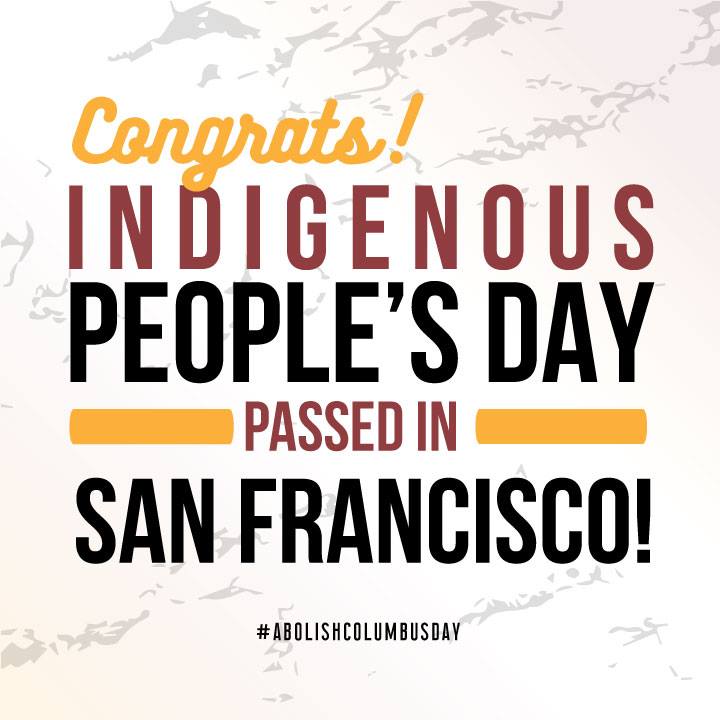
It took 15 years before the first city – Berkeley, CA – renamed Columbus Day to Indigenous Peoples’ Day in 1992. While Santa Cruz, CA followed shortly after in 1994, it took another 22 years before Minneapolis, MN, Grand Rapids, MN, and Seattle, WA did the same in 2014. Since then, over 70 cities and states, as well as numerous universities nationwide, have switched to the new name. Among the latest to make the switch are San Francisco, CA, West Hartford, CT, and Lawton, OK.
The movement has also spread to Latin American countries. “Dia de la Raza,” or “Day of the Race,” as the day is called in Argentina, Chile, Costa Rica, Ecuador, Honduras, Mexico, Uruguay, and Venezuela, honors the people and cultural influences ushered in by Christopher Columbus, rather than the explorer. However, many feel it is a reminder of the past, and current, struggles faced by the indigenous population. To acknowledge their plight, Venezuela and Nicaragua call it “Day of the Indigenous Resistance.” Argentina renamed the holiday, “Day of Respect for Cultural Diversity,” while Chile changed it to “Día del Descubrimiento de Dos Mundos,” or “Day of the Encounter Between the Two Worlds.”

Not everyone agrees changing the name is necessary. Italian Americans, who have made Columbus Day the focal point of the Italian Heritage Month celebrated throughout October, argue that the holiday marks the history of immigration, not the explorer. They, therefore, believe the name should be retained or perhaps changed to something more suitable, like Italian Heritage Day. What do you think? Be sure to let us know by adding your comments below.
Resources: Wikipedia.org, Independent.com, History.com

Get the Workbook for this article!
Workbook contains: Article, Reading Comprehension, Critical Thinking Questions, Vocabulary in Context (+ answers), Multiple Choice Quiz (+ answers), Parts of Speech Quiz (+ answers), Vocabulary Game (+ answers)Cite Article
Learn Keywords in this Article

679 Comments
- A smart personover 7 years@wolfdog ok Ms. Texas, true he did cross the ocean. But so did the Vikings. Oh, and the Native Americans. But yeah, i guess he did colinize America. But if you actually read the article, it said he and his army “ruthlessly killdeer millions of indigenous people who tried to resist. Those who survived were enslaved and forced to work in mines and plantations.”
- ccover 7 yearsok this is weird
- fake aliasover 7 yearsok im fine with this
- BunnieLoverover 7 yearsI think it should be a different name because i am native american and columbus was not nice to them
- yeloover 7 yearsthis is cool
- yeloover 7 yearsyipee
- Columbus Dayover 7 yearsccln I disgree with you.
 elisee23over 7 yearsI'm not sure because I'm Canadian, not American lol..... But I think that if they can't agree... There should be no holiday at all! Maybe instead of a holiday there is a few minutes of silence to remember the indigenous people.
 wolfdogover 7 yearsWhy get rid of the explorer who dared to cross this entire ocean, not certain of fate, in a wooden boat with only crumbs as meals and illness high? Crossed the entire Atlantic, thinking it was 'India' at first. But later discovered many people, who have been within the land for thousands of years. Yet have not evolved much, they did not have iron, they did not have paved roads, they did not even have clothes that looked sophisticated. And everybody knows Europe loved to conquer things back in the old days. So. They conquered. And, was it the European's faults for causing illness to the Native Americans? No. They were simply not immune to viruses, vice versa. Small wars raged out, and no, the Europeans were not 'evil' nor were the Native Americans. It was just simply the age of conquering, that was the Old World's thing. (Even the Native Americans conquered local tribes and had small wars.) Nobody is better, reminder. It's just, there would be no America if it weren't for Columbus!
- The guyover 7 yearsI don’t think I have any idea
